Ship It Scared: What Happens When You Stop Waiting to Feel Ready and Just Release the Thing
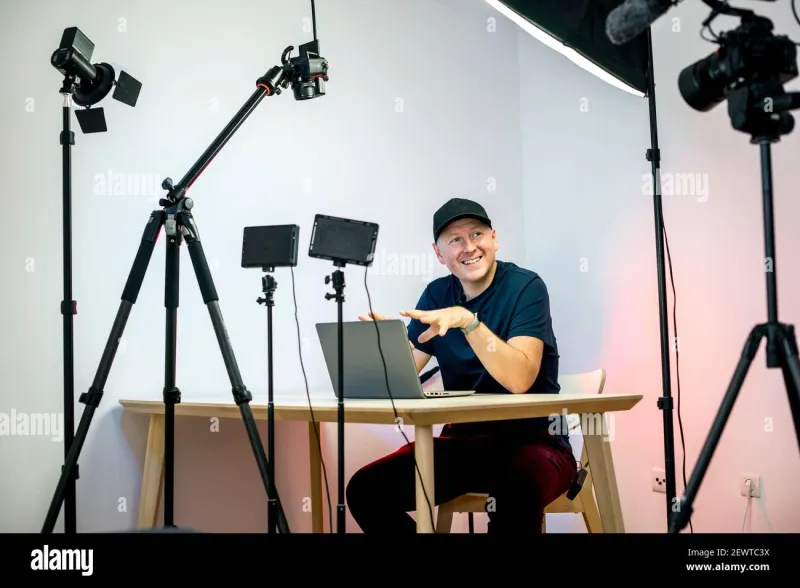
Photo: creative professional nervously pressing publish on laptop in home studio, via c8.alamy.com
Here's a question worth sitting with: What's the boldest project you've never made?
Not the one that wasn't technically feasible. Not the one you didn't have the budget for. The one you had every resource to create and still didn't — because something quieter and harder to name kept stopping you.
For a lot of creators, that thing is fear. Not the dramatic, identifiable kind. The sneaky kind that disguises itself as perfectionism, or strategic timing, or "I just need a little more research." The kind that keeps your most interesting work locked inside a folder you open once a month and then close again.
We talked to a handful of working creators about the projects they were terrified to release — and what actually happened when they did.
The Fear Has a Specific Name
There's a term researchers use for it: katagelasticism — the fear of being laughed at. But in creative circles, it tends to show up less as a fear of mockery and more as a fear of exposure. The worry isn't really that people will laugh. It's that people will see you clearly — see the thing you made, the perspective baked into it, the part of yourself you couldn't edit out — and find it lacking.
That's a much scarier proposition than a bad review.
"The work I hold back is always the work that's most personal," says Marcus, a documentary filmmaker based in Austin who spent two years sitting on a short film he'd made about his father's immigration story. "I'd edit it, re-edit it, tell myself it wasn't ready. But the real issue was that it was too ready. It was done. I just didn't want to find out what people thought of something that actually mattered to me."
He released it. It got into three regional festivals and opened a distribution conversation he's still in the middle of. The version he almost never released.
What "Not Ready" Usually Means
There's a useful exercise: the next time you catch yourself saying a project isn't ready, try replacing that phrase with "I'm scared to find out how this lands." See if it still feels accurate.
For most creators, it does. And that's not a character flaw — it's a signal that the work means something to you. The projects we're cavalier about releasing are usually the ones we're cavalier about in general. Fear is often just evidence of investment.
The problem is that "not ready" is an infinitely renewable excuse. There is always something else to refine. There is always a better moment to release. There is always a reason to wait — until you've been waiting so long that the project quietly becomes a ghost that haunts your hard drive.
The Compounding Cost of Waiting
Here's what doesn't get talked about enough: the creative cost of not shipping.
Every project you hold back takes up psychic real estate. It sits in the back of your mind, unresolved, drawing energy that could be going toward the next thing. And because it's unfinished in the only way that matters — it hasn't met its audience yet — it can start to feel larger and more loaded the longer it stays unreleased.
"I had a web series I'd shot and edited and scored and it was just... sitting there," says Danielle, a content creator from Chicago who runs a production channel with around 80,000 subscribers. "And the longer it sat, the more I built it up in my head. By the time I finally released it, I was convinced it was either going to be the best thing I'd ever done or completely ruin my credibility. It was neither. It was just a good project that people liked. And I'd spent eight months being paralyzed by a story I made up about it."
The gap between how catastrophic we imagine the response will be and how the response actually lands is, in most cases, enormous.
Practical Ways to Break the Loop
Knowing the fear is irrational doesn't make it go away. But there are some concrete moves that can help.
Set a ship date before you're done. Announce the release date to someone — a collaborator, a small audience, even just a friend — before the project is finished. External accountability is a remarkably effective antidote to internal perfectionism.
Separate the release from the reception. Shipping the work is entirely within your control. How it's received is not. When you conflate those two things, you're letting an imaginary future audience make decisions that are yours to make right now.
Release something smaller first. If the big project feels too loaded, find a lower-stakes version of the same creative risk. Test the waters with a clip, a behind-the-scenes post, a teaser. Build evidence that vulnerability doesn't destroy you.
Talk to someone who's shipped scared. Seriously. Find a creator whose work you respect and ask them about the project they almost didn't release. Almost everyone has one. Hearing that story firsthand does something that no article can fully replicate.
The Thing About the Other Side
Every creator we spoke with said some version of the same thing: the fear didn't go away before they released the work. They released it scared. And the act of releasing it — not the reception, not the metrics, but the act itself — was what changed something.
"I kept waiting to feel confident," Marcus told us. "What I figured out is that confidence comes from doing the thing, not before it. You don't get to feel ready first. You get to feel ready after."
That reframe is worth keeping close.
The Lemon Dog Take
At Lemon Dog Media, we think the most interesting creative work almost always lives right at the edge of what a creator is willing to risk. The projects that feel a little too personal, a little too weird, a little too much like a bet on yourself — those are the ones worth making.
The world doesn't need another safe project. It needs the one you've been afraid to release.
Ship it scared. See what happens.