Your Laundromat Is the New Backlot: The Case for Filming in Places That Make No Sense
There's a moment every creator knows: you've got the shot list, the script, maybe even a rented space with clean white walls and bounce cards already set up. And the whole thing feels... fine. Fine is the enemy.
Now picture this instead. You're crouched between two industrial dryers at 11 p.m., taping a phone to a detergent shelf because your tripod leg won't fit. The fluorescent lights are doing something weird and wonderful to your subject's face. Nobody planned this. And the footage? Genuinely alive.
That's the off-script effect, and it's more than a vibe — it's a repeatable production strategy.
Constraints Are a Cheat Code
Here's the uncomfortable truth about perfect environments: they remove the need to solve problems, and problem-solving is where style gets invented. When everything's available, nothing forces a choice. When almost nothing is available, every frame becomes a decision.
Filmmakers have known this forever. Steven Spielberg shot Jaws in actual open water, and the mechanical shark's constant failures accidentally invented the greatest suspense technique in blockbuster history. Robert Rodriguez famously made El Mariachi for a few thousand dollars by building his visual language around whatever he could physically get his hands on — a wheelbarrow as a dolly, a borrowed turtle as a prop. The constraints didn't limit the look. The constraints were the look.
Your version doesn't need to be that dramatic. It just needs to be inconvenient.
Where to Point Your Camera
If you're hunting for locations that will push you, start with places that have personality baked in:
- Laundromats. Fluorescents, spinning drums, waiting strangers. Free production design that most studios would charge to fake.
- Parking garages. Concrete geometry, sodium-vapor color casts, and echo for days. Instant mood.
- Backyards at golden hour. The most underrated set in America. String lights, a fence, a folding chair — that's a whole aesthetic.
- 24-hour diners. Booth lighting, coffee steam, and a color palette you cannot recreate under studio LEDs.
- Hardware stores and dollar stores. Aisles of props for the price of a snack run.
The common thread: these places come with texture, sound, and light that you'd spend real money trying to simulate. You're not settling for less polish. You're borrowing atmosphere for free.
The Gear-Light Playbook
Shooting in weird places doesn't mean shooting badly. It means packing like a pickpocket instead of a moving truck. A few things that earn their space:
- One fast lens. A 35mm or 50mm prime handles weird lighting better than a zoom ever will, and the limitation keeps your framing decisive.
- A small LED panel with a gel. Two minutes of setup turns a laundromat into a crime thriller or a rom-com depending on the color.
- Gaff tape and a phone mount. Half of guerrilla rigging is just attaching things to other things.
- A lav mic or a dead cat for your shotgun mic. Weird locations come with weird noise. Plan for it or lose the take.
- Batteries. Always more batteries. There's no outlet behind the vending machine. We checked.
Notice what's missing: the full lighting kit, the monitor, the cart with three drawers of accessories. You're not building a set. You're raiding one.
How Weird Sets Build Your Signature
Here's the long-game benefit nobody talks about. When every creator has access to the same ring light and the same seamless backdrop, everyone's footage starts to rhyme. But nobody else has your uncle's garage, your city's worst parking lot, or the specific sadness of a laundromat at midnight.
Creators who build recognizable visual signatures almost always find them in specific places, not generic ones. The grainy diner look. The garage-band lighting. The backyard chaos. Audiences can't always name why it feels distinct — they just know it does. Location is a fingerprint.
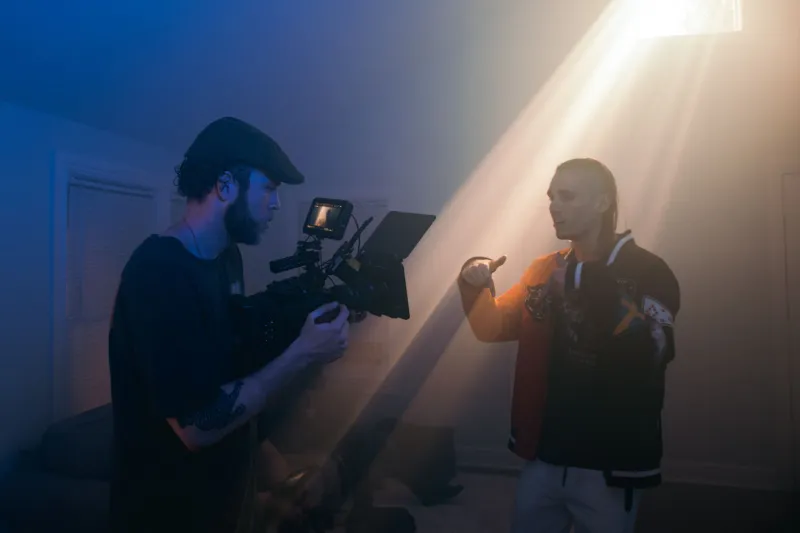
And practically? Shooting in the real world trains skills that studio comfort never will: reading available light fast, adapting when a stranger walks through frame, making a shot work with what's actually there. Those skills transfer everywhere. The creator who can make a laundromat cinematic can make anything cinematic.
Before You Go
A quick dose of responsibility, because "off-script" should never mean "off the rails":
- Ask permission. Most small business owners will say yes to a polite creator, especially if you offer to tag them or send the footage. A two-minute conversation beats getting escorted out.
- Scout at the time you'll shoot. Light and foot traffic change everything between 2 p.m. and midnight.
- Keep crews tiny. Two people with a camera look like customers. Seven people with a cart look like a production. Guess which one gets asked to leave.
- Leave it better than you found it. The indie creator community is small. Don't be the reason a laundromat owner says no to the next person.
Get Out of the Box (Literally)
The polished studio will always be there when you need it. But if your recent work has felt flat — technically clean, creatively asleep — the fix probably isn't more gear or a better backdrop. It's less of both.
Grab the camera, grab one lens, and go find a place that makes no sense on paper. The discomfort you feel setting up in a weird spot is the same discomfort your audience feels when everything looks like everyone else's content. Only one of you is going to do something about it.
Now if you'll excuse us, there's a laundromat on 5th that's been asking for its close-up.